

How To Change System Files In Windows 7
Normally, you lot don't accept to worry well-nigh permissions in Windows because that's already taken care of by the operating organization. Each user has their ain contour and their ain set of permissions, which prevents unauthorized access to files and folders.
There are times, all the same, when you might want to manually configure the permissions on a set of files or folders in order to prevent other users from accessing the data. This post is assuming the other "people" also have admission to the aforementioned computer you are using.
If not, you may too merely encrypt your hard drive and that'south it. However, when others tin can access the computer, like family unit or friends, then permissions tin can come in handy.
Of course, there are other alternatives like hiding files and folders using file attributes or by using the control prompt to hide data. Yous tin can even hibernate an entire drive in Windows if you like.
If you are looking to set permissions in club to share files with others, cheque out my post on creating a hidden network share or how to share files across computers, tablets and phones.

Data Security
The only other occasion where you will need to mess effectually with binder or file permissions is when y'all get a Permission Denied error when trying to admission information. This means yous can accept ownership of files that don't vest to your electric current user account and still access them.
This is important because it ways that setting permissions on a file or binder does not guarantee the security of that file or folder. In Windows, an administrator on any Windows PC tin can override the permissions on a set up of files and folders by taking ownership of them. In one case y'all have ownership, you can set your ain permissions.
And so what does this mean in English? Basically, if you take information yous don't want others to see, and then you should either not store it on that computer at all or you should use an encryption tool like TrueCrypt.
For those tech-savvy readers, you'll probably be maxim "Hey expect, TrueCrypt has been discontinued due to security vulnerabilities and shouldn't be used!" Well, that is right, nonetheless, TrueCrypt has been audited past an independent organization and Stage I and Phase II have been completed.
The only version y'all should download is TrueCrypt seven.1a, the 1 that has been uploaded to a verified mirror on GitHub. If you are not comfortable at all using TrueCrypt, the merely other suggestion I have is VeraCrypt, which was the successor to TrueCrypt, just fixed many of the flaws.
File and Folder Permissions
Now that we got all of that out of the way, allow'southward talk almost permissions in Windows. Every file and every folder in Windows has its own set of permissions. Permissions can be broken down into Access Control Lists with users and their corresponding rights. Here is an example with the user listing at the top and the rights at the lesser:
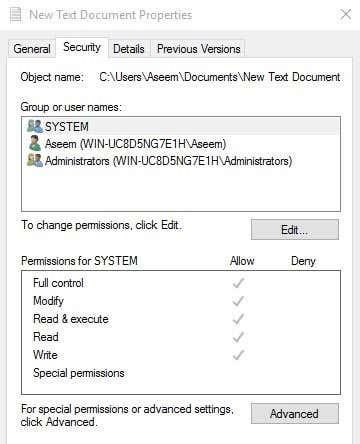
Permissions are too either inherited or not. Normally in Windows, every file or folder gets their permissions from the parent binder. This hierarchy keeps going all the manner upward to the root of the hard drive. The simplest permissions have at least three users: Organization, currently logged in user account and the Administrators grouping.
These permissions usually come from the C:\Users\Username folder on your difficult drive. You can access these permissions by correct-clicking on a file or folder, choosing Properties and then clicking on the Security tab. To edit permissions for a particular user, click on that user and and then click the Edit button.
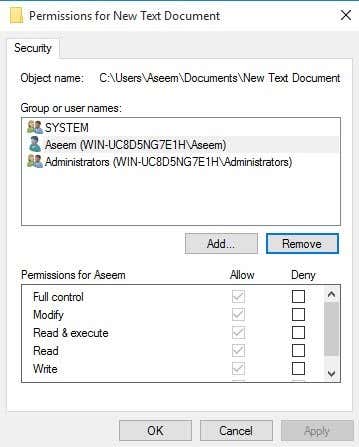
Annotation that if the permissions are greyed out, like in the example higher up, the permissions are existence inherited from the containing binder. I'll talk about how you tin can remove inherited permissions further below, but starting time permit's understand the dissimilar types of permissions.
Permission Types
In that location are basically six types of permissions in Windows: Full Control, Alter, Read & Execute, Listing Folder Contents, Read, and Write. List Binder Contents is the but permission that is exclusive to folders. There are more advanced attributes, simply you'll never need to worry about those.
So what practise each of these permissions hateful? Well, here is a prissy nautical chart from Microsoft's website that breaks on what each permissions means for files and for folders:
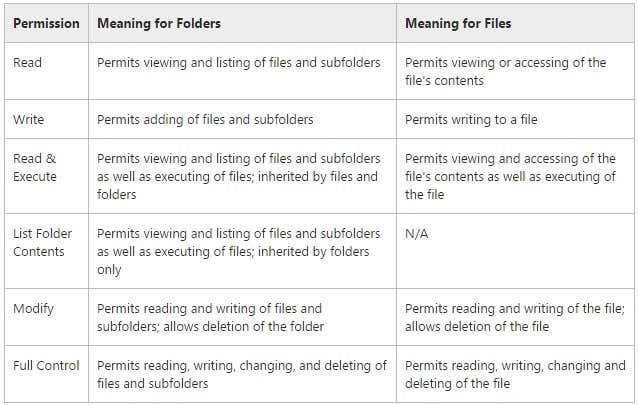
Now that y'all understand what each permission controls, let's take a look at modifying some permissions and checking out the results.
Editing Permissions
Before you tin can edit whatever permissions, you have to take ownership of the file or folder. If the owner is another user account or a organization account like Local Organization or TrustedInstaller, you won't be able to edit the permissions.
Read my previous mail on how to have ownership of files and folders in Windows if you are currently not the owner. Now that you are the possessor, let's get a few more things out of the way:
-
If you ready Full Command permissions on a binder for a user, the user volition be able to delete any file or subfolder regardless of what permissions are set for those files or subfolders.
-
By default permissions are inherited, then if you lot want custom permissions for a file or folder, yous have to first disable inheritance.
-
Deny permissions override Let permissions, so apply them sparingly and preferably only on specific users, not groups
If yous correct-click on a file or folder, cull Properties and click on the Security tab, we tin can at present try to edit some permissions. Become alee and click the Edit button to go started.
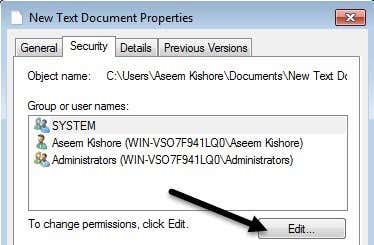
At this point, at that place are a couple of things you tin can do. Firstly, you lot'll notice that the Allow column is probably greyed out and can't exist edited. This is because of the inheritance I was talking about earlier.
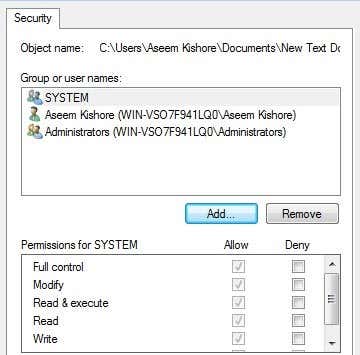
However, you can cheque items on the Deny column. So if you lot just want to block access to a folder for a specific user or group, click the Add button commencement and once added, y'all tin can cheque the Deny push next to Full Command.
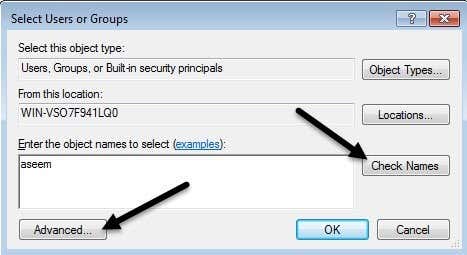
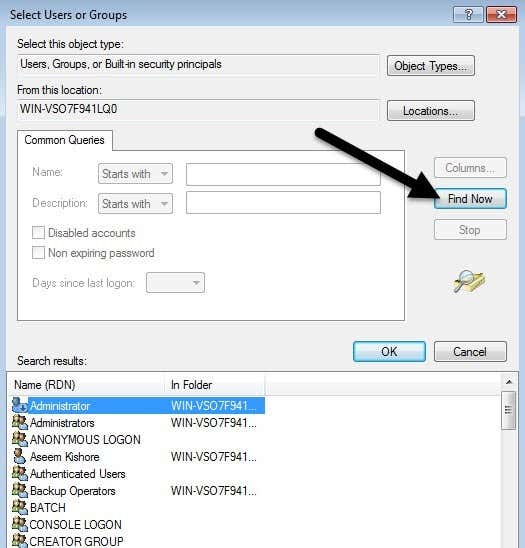
When you lot click the Add button, yous have to blazon in the user name or group name into the box then click on Check Names to make certain it's right. If you don't remember the user or group name, click on the Advanced button and so only click Discover Now. Information technology will show you all the users and groups.
Click OK and the user or grouping will be added to the access control list. Now you lot can cheque the Allow column or Deny column. Every bit mentioned, try to utilize Deny just for users instead of groups.
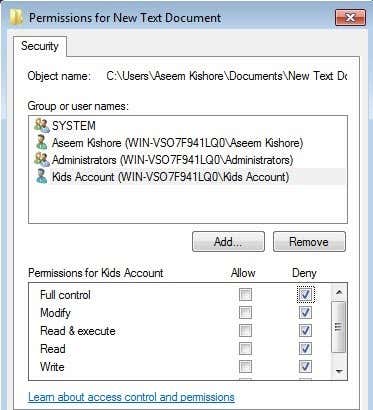
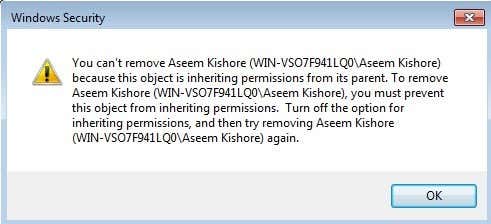
Now what happens if we try to remove a user or group from the list. Well, you tin can easily remove the user you lot but added, but if you endeavour to remove whatever of the items that were already there, you'll go an error message.
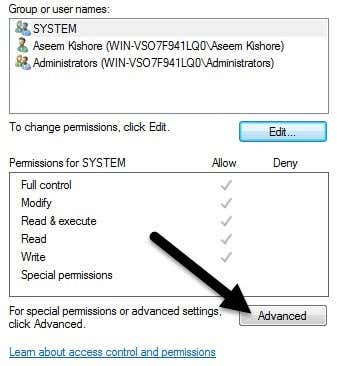
In society to disable inheritance, yous have to go back to the main Security tab for the file or folder and click on the Advanced button at the bottom.
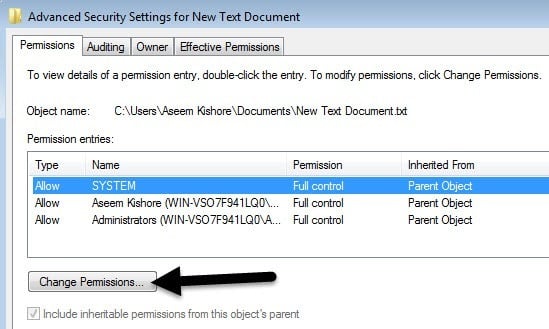
On Windows seven, you lot'll ane extra tab for Possessor. In Windows 10, they just moved that to the top and yous take to click Alter. Anyway, in Windows seven, click on Modify Permissions at the bottom of the outset tab.
On the Avant-garde Security Settings dialog, uncheck the Include inheritable permissions from this object's parent box.
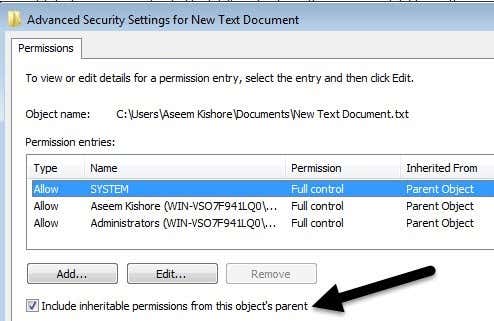
When y'all do that, some other dialog box volition popup and information technology will ask you whether you want to convert the inherited permissions to explicit permissions or whether yous just want to remove all the inherited permissions.
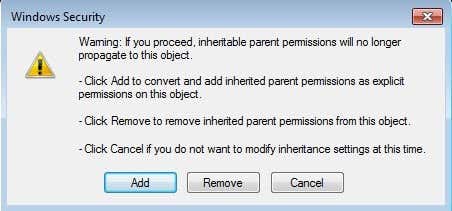
Unless y'all really know exactly what permissions you lot want, I advise choosing Add (explicit permissions) and then but removing whatever you don't want afterwards. Basically, clicking on Add together volition proceed all the aforementioned permissions, but at present they won't exist greyed out and you can click Remove to delete any user or group. Clicking Remove, will start you off with a clean slate.
In Windows 10, it looks slightly different. After clicking on the Avant-garde button, you have to click on Disable Inheritance.
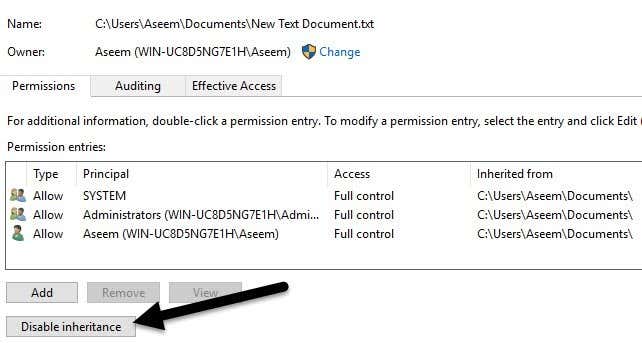
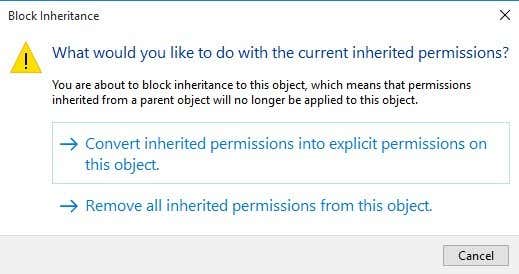
When you click on that button, you lot'll go the same options as in Windows vii, simply just in a different form. The Convert option is the aforementioned every bit Add together and the second pick is the aforementioned equally Remove.
The only matter you lot have to empathize at present is the Effective Permissions or Effective Access tab. Then what is constructive permissions? Well, let's see the case above. I take a text file and my account, Aseem, has Full Control. Now what if I add another detail to the list then that the group Users is denied Total Control.
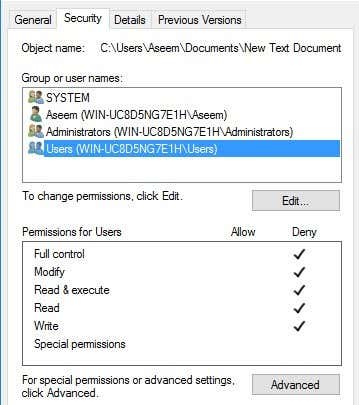
The only problem hither is that the Aseem account is also role of the Users grouping. So I have Total Control in i permission and Deny in some other, which 1 wins? Well, equally I mentioned above, Deny always overrides Allow, and then Deny will win, but we can likewise confirm this manually.
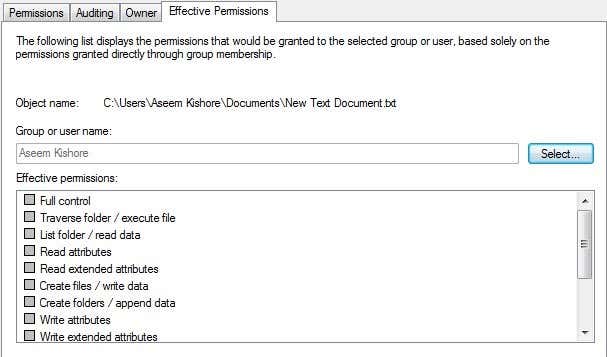
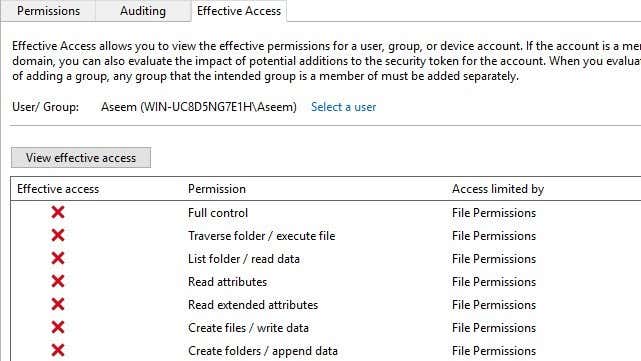
Click on Avant-garde and get to the Effective Permissions or Effective Access tab. In Windows 7, click the Select button and type in the user or grouping name. In Windows 10, click the Select a user link.
In Windows 7, in one case y'all select the the user, information technology will instantly show the permissions in the list box below. As you tin can see, all of the permissions are unchecked, which makes sense.
In Windows x, yous have to click the View effective admission button afterward selecting the user. You'll also become a overnice crimson X for no admission and a greenish check mark for immune access, which is a scrap easier to read.
So now you pretty much know all there is to know about Windows file and folder permissions. It does take some playing effectually yourself in order to get the hang of it all.
The main points to understand are that you demand to exist the owner in order to edit permissions and that whatsoever administrator can take buying of files and folders regardless of the permissions on those objects. If y'all have any questions, experience free to mail a comment. Savor!
Do not share my Personal Information.
Source: https://www.online-tech-tips.com/computer-tips/set-file-folder-permissions-windows/
Posted by: duppstadtvoiceselen.blogspot.com
0 Response to "How To Change System Files In Windows 7"
Post a Comment